

As anyone who’s studied even a little economics knows, the law of supply and demand usually dictates that when supply increases, prices drop and vice versa.
Yet, when it comes to real estate Portland has managed to achieve the dubious distinction of being both unaffordable and undesirable. For the second year in a row, a closely watched national real estate survey from the Urban Land Institute has ranked the Portland metro area 80th out of 81 U.S. commercial real estate markets it monitors.
There are explanations for the ranking that reconcile it with economic theory. The problem: None of those explanations cast Portland in a good light. The most important thing to note is that the study combines multiple elements of the real estate market, some of which have contradictory trends. For example, Portland housing is expensive but commercial real estate, especially downtown, is comparatively cheap. The problem: Both types of real estate are sitting at unhealthy price levels – though at the opposite end of the scale. And government decisions are making both problems worse.
Let’s look at the components of the study piece by piece.
Residential housing
Portland’s ranking for homebuilding prospects was 30th, significantly better than its overall rating. That’s because there is demand for substantially more residential housing than currently exists – a circumstance that should be appealing to developers.
The ranking almost certainly would have been higher except for a perennial problem: It takes longer and is more expensive to build here than in many other cities. That remains true even after efforts to streamline regulations, which have at best been marginally successful. That’s in part because for every good idea to encourage housing there’s been a worse idea to offset it. Rent control, which makes it less attractive to build new housing, and project labor rules, which drive up the cost of building by mandating union wages, are two examples.
Commercial retail space
The Urban Land Institute breaks commercial real estate into multiple categories, but I’m focusing on retail and office, the two largest non-housing sectors and the ones struggling the most in the Portland area.
Portland has for years ranked relatively low on retail space per capita compared with other cities. It’s not clear why Portland has less retail footage than other cities, though the cost of land, regulatory obstacles and the popularity of online shopping among area residents likely are significant factors. In recent years, the decline of downtown Portland is another factor.
This much is clear: The Portland area has lots of underutilized retail space, from prominent examples such as empty stores downtown and the downtrodden Lloyd Center to small, almost forgotten strip shopping centers throughout the metro area. Even the most successful of the traditional malls in the Portland area, Washington Square, faces constant churn and in particular struggles to find strong anchor stores as department stores, traditional mall anchors, decline.
To be fair, some of the problems facing retail, such as the popularity of online shopping and high interest rates (which both reduce shoppers’ purchasing power and make it more expensive to redevelop under-used buildings) are national and mostly beyond the control of local businesses and government alike.
But as population growth has plateaued, and in cases declined, and Portland’s reputation for livability has evaporated, the city’s longtime weakness, over-regulation, has become more pronounced. Oregon’s lack of a sales tax remains a positive for retailers, but that advantage is offset by increases in virtually every other type of tax, which reduces consumers’ ability to spend.
Commercial office space
While the retail and housing sectors face challenges in the Portland area, the commercial office market faces an existential challenge.
According to the widely watched Colliers commercial real estate report, the office vacancy rate in the Portland area reached a record 26.6 percent in the third quarter. Colliers pegged the downtown vacancy rate at 34.6 percent, and downtown property owners told Willamette Week they think the Colliers rate underestimates the problem. After a stroll through downtown, it’s easy to see why property owners feel that way.
Portland’s highest profile effort to help the downtown office market has been to urge businesses to require workers to return to the office. But that effort is more than a bit hypocritical since the city of Portland is one of the biggest downtown employers and continues to allow many of its employees to work from home, in part because of union resistance.
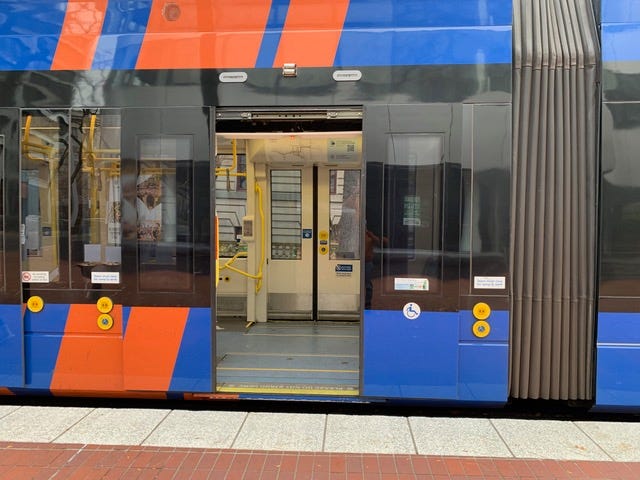
The city also has made too little progress on improving the ambience and safety of downtown, though they have made more effort under Mayor Keith Wilson and probably made more progress than critics think. Still, even the strongest defender of downtown would have a hard time convincing a neutral observer that is a “welcoming” place for a business, as the Urban Land Institute survey reveals.
The Urban Land Institute survey focuses on a specific issue (real estate) and people involved in that industry. However, it isn’t the only one showing a growing consensus that Oregon’s policies aren’t working. The group Save Our Cities commissioned a survey on Oregon’s business climate seeking the opinion of residents, not just businesses. The results were equally negative. Respondents gave the state’s business climate a D+, with 67 percent saying the Oregon economy is “pretty seriously off on the wrong track.”
Overall impression
All three surveys match my personal impression. I’ve been downtown twice in the past month, once for a meeting in one of the major office towers and Saturday to see what downtown looked like on a weekend. I’ll readily admit, as I’ve noted frequently on X, short visits only reveal what’s happening at a given time. But to make my observations as meaningful as possible, I tried to approach them with logic. The meeting was at 2 p.m., not peak time for downtown foot traffic but a fairly common time for business meetings. In fact, I attended mid-afternoon meetings in the same building when I was working downtown. I never saw as few people in or around the building.
Then on Saturday, I went between 11 a.m. and noon, not the busiest time but a time when there should be some people shopping and looking for restaurants. I started by checking out three places at which I ate frequently during the 20 years I worked downtown at The Oregonian. I expected one or two spots to be vacant and probably all to have different tenants. All three were vacant. These used to be prime spots.
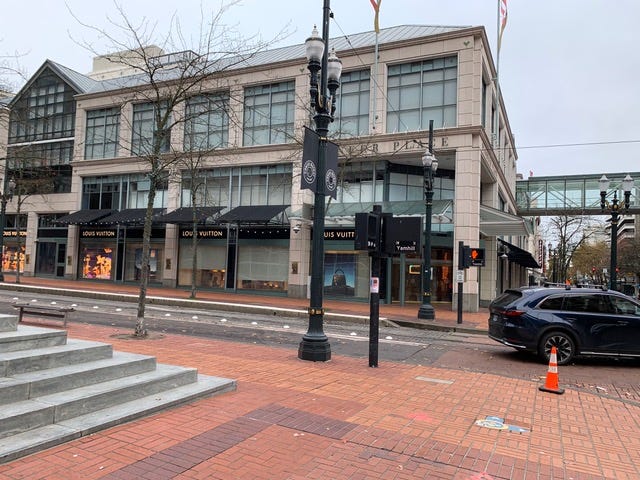
Then I checked Pioneer Place, including the food court. Only one restaurant had customers. There were more people in the mall than other places downtown but certainly not enough to convince a retailer to open a store there. Other places, I mostly saw empty buses and trains. On the positive side, downtown Portland remains pretty, especially in the fall, and the homeless problem is most noticeable in a few areas mostly on the fringe.
With the current combination of national trends and local policies, it’s hard to see downtown rebounding anytime soon.
This article originally appeared in the Oregon Roundup.