

Oregon Governor Tina Kotek yesterday issued a letter to her Department of Transportation Director to clarify she expects the six-cent gas tax hike now pending before the legislature now meeting in special session to “go directly toward road maintenance and agency operations.” (Emphasis added). The Oregon Constitution requires all revenue from the gas tax must be used exclusively for construction and maintenance of roads.
Kotek’s letter, which she issued to combat Republican attacks that the tax hike bill does not specifically restrict revenue increases to use on roads, did not address whether the state is using current gas tax revenues for purposes other than roads.
The letter comes at a delicate political time for the Governor, who summoned legislators to the Capitol for Labor Day Weekend in a second attempt to pass tax and fee increases she says are necessary to prevent transportation worker layoffs and degredation in road conditions. In June, a more ambitious package failed, as moderate Democrats and Republicans refused to deliver the votes Kotek needed.
The current proposal, at $5.8 billion still the largest transportation tax increase in Oregon history, is more modest, and is widely seen as a high-stakes political test for the Governor just 14 months before voters will decide whether to re-elect her.
Oregon voters amended the state constitution in 1980 to require the state to use gas tax revenue exclusively on roads. That provision is at Article IX, Section 3a of the constitution.
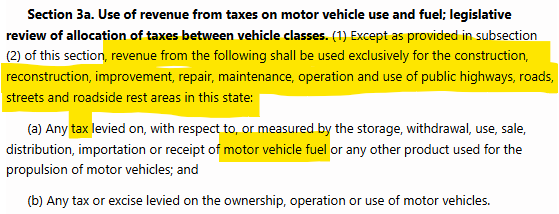
The Constitution allows for spending of gas tax revenue on “the cost of administration” of road construction and maintenance, but does not allow for broad use on “agency operations.”
Over the decades since the amendment, state and local governments have tried to use gas tax revenue for things other than roads, such as parking lots and covered walkways. Oregon courts have stricken many of those uses down as unconstitutional, have consistently observed that courts will strictly enforce the constitutional restrictions on the use of gas tax funds, and have adopted the following test:
[E]xpenditures of motor vehicle and fuel taxes within the meaning of `improvement, operation and use’ must be limited exclusively to expenditures on highways, roads, streets and roadside rest areas themselves and for other projects or purposes within or adjacent to a highway, road, street or roadside rest area right-of-way that primarily and directly facilitate motorized vehicle travel.
In addition to road maintenance, the Oregon Department of Transportation conducts operations including climate change and diversity equity and inclusion initiatives, registering voters, promoting electric vehicles, and encouraging people to ride bikes or walk instead of drive on roads.
Kotek has repeatedly asserted she will be forced to lay of 500-600 ODOT workers if the legislature fails to raise taxes. Melissa Unger, who runs SEIU 503, the powerful state worker union that represents approximately 2,500 ODOT workers and is a close ally and campaign funder of Kotek, appeared at a rally at the Capitol this morning to urge legislators to vote for the package, according to the Statesman-Journal. SEIU represents maintenance as well as administrative and Department of Motor Vehicle employees at ODOT.
Today is the first day of what looks to be a multi-day special session to consider Kotek’s tax package, with votes in the House and Senate perhaps taking place early next week.
This article originally appeared in the Oregon Roundup.