
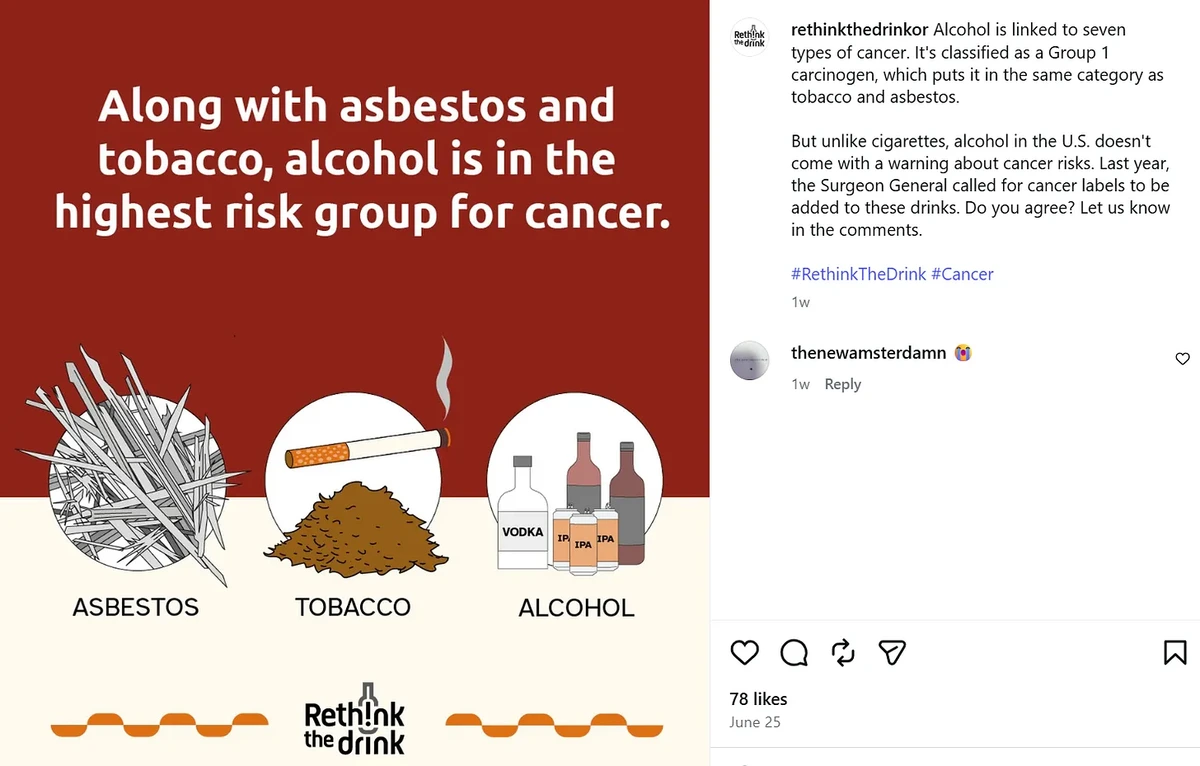
An Oregon Health Authority social media campaign claims alcohol is in the “highest risk group for cancer” with notorious carcinogens asbestos and tobacco, even though the World Health Organization, which publishes the carcinogenic hazard categories, says the categories do not describe cancer risk.
OHA’s comparison of alcohol with notorious high-risk carcinogens has drawn the ire of alcohol industry groups and a bipartisan coalition of legislators seeking to promote Oregon’s wine industry as Governor Tina Kotek (D) strives to portray the state as business-friendly as she runs for re-election against Republican State Senator Christine Drazan.
The OHA’s June 25 Instagram post, part of the agency’s anti-alcohol campaign it calls Rethink the Drink says, “Along with asbestos and tobacco, alcohol is in the highest risk group for cancer,” with images of asbestos fibers, a lit cigarette and vodka, beer and wine bottles. In a comment to the post, OHA explains alcohol is linked to seven types of cancer and is classified as a Group 1 carcinogen, like asbestos and tobacco.
The Group 1 classification refers to cancer hazard categories established and maintained by the WHO’s Lyon, France-based International Agency for Research on Cancer. The IARC classifies chemicals, air pollution, pharmaceuticals and behaviors, all of which are referred to as “agents,” into four categories based on whether existing scientific research shows the agent in question is capable of causing cancer in humans. Group 1 includes asbestos, tobacco, alcohol and cured meats such as hot dogs and sunlight for which IARC believes there is sufficient evidence the agent can cause cancer in humans. Groups 2, 3 and 4 include agents for which there is less evidence the included agents can cause cancer.
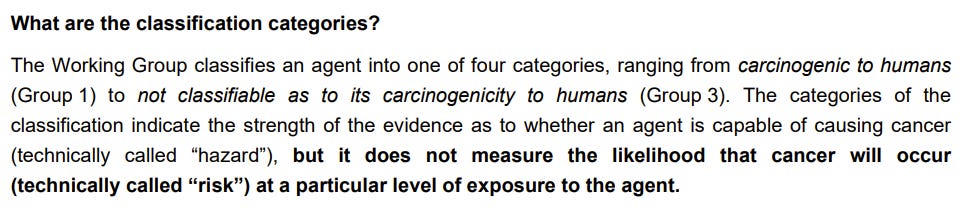
However, the IARC emphasizes the four categories do not describe the risk an agent will cause cancer:
The categories of the classification indicate the strength of the evidence as to whether an agent is capable of causing cancer (technically called a “hazard”), but it does not measure the likelihood that cancer will occur (technically called “risk”) at a particular level of exposure to the agent.
(Emphasis in original).
So, Group 1 includes agents, like asbestos and radioactive particles, for which there is no safe exposure level, as well as sunlight and alcohol, which are regularly encountered by human beings without materially increasing the risk of developing cancer. Inclusion in Group 1 simply means there is scientific evidence the agent is capable of causing cancer.
The U.S. Surgeon General issued an advisory last year asserting alcohol increases the risk of developing at least seven types of cancer, including mouth, throat, larynx, esophogeal, liver and colon cancer, and breast cancer in women. However, the advisory uses a baseline of “less than one drink per week,” and compares higher consumption rates with corresponding higher risk rates.
Meanwhile, The Mesothelioma Center says “no level of asbestos exposure is considered safe,” with even a few hours of exposure to asbestos fibers creating a moderate risk of causing cancer. The high cancer risk of asbestos has caused federal, state and local governments to ban almost all uses of asbestos in construction, and to define strict protocols for removing asbestos from structures intended to eliminate human contact with the fibers.
Oregon has no legal regime seeking to eliminate human consumption of alcohol. Indeed, the Oregon legislature created and funds via state wine taxes the Oregon Wine Board, which promotes the sale of wines manufactured in the state, and provides updates on opportunities to drink wine at Oregon vineyards. Wine Board members are appointed by the Governor.
Just a month before her administration compared wine to asbestos, Kotek heralded Oregon Wine Month in a May 28 post on the social media platform X, formerly known as Twitter. In the post, Kotek congratulated Oregon vintner Susan Sokol Blosser for receiving an award from the Oregon Department of Agriculture for her dedication to the state’s “world-renowned wine industry.” The post says, “Oregon wine supports 38,000+ jobs and nearly $8.5B in economic impact.” The post does not mention the OHA’s assertion about cancer risk.
The Governor appointed Lois Cho, CEO and co-founder of CHO Wines in Hillsboro to the Prosperity Council, which last month urged Kotek to cut taxes and reduce the burden state agencies place on businesses to reverse Oregon’s slide in many measures of economic and business performance.
The OHA’s cancer claims triggered a rapid and forceful response. A collection of Oregon alcohol industry groups sent a letter to Dr. Sejal Hathi, then-director of OHA, June 26 complaining about the effect of the agency’s assertion about alcohol-related cancer risk on the state’s economy. The groups pointed out Americans are drinking less, and many Oregon breweries, taprooms and wineries have closed since the pandemic.
Hathi responded to the industry groups July 2, asserting the agency’s social media post comparing risks from alcohol to those from tobacco and asbestos “accurately reflected” the IARC hazard categories that the IARC says do not address or compare risk. Four days later, Kotek announced Hathi was resigning as director effective August 1 “to focus on family, personal priorities, and the next chapter of life and service.” Hathi recently gave birth to her first child after raising eyebrows by accepting a part-time faculty position at Stanford University while helming OHA, which has a $20 billion budget.
Oregon Roundup Foundation asked OHA for additional comment on the agency’s use of the term “risk group” in light of WHO’s disclaimer that the groups do not define risk. OHA did not provide comment by deadline.
The Oregon Legislative Wine Caucus, a bipartisan group of 14 legislators supportive of the state’s wine industry, sent a letter to OHA earlier this week, calling the cancer risk post “misleading,” and expressing frustration at OHA, the Oregon Wine Board and the Oregon Liquor and Cannabis Commission “spending state dollars with frequently conflicting messages and goals” regarding alcohol.
This is not the first time OHA’s Rethink the Drink campaign has caused controversy. In 2024, the agency came under fire from the alcohol industry and business advocates for failing to make public a study showing a beer and wine tax increase would likely have little effect on reducing the negative effects of excessive alcohol consumption. Instead of presenting the study to a state task force evaluating a tax hike, the agency originally deployed portions of a draft version of the study but omitting the minimal effect of tax hikes. When The Oregonian reported OHA kept the study secret, OHA deflected and the task force ultimately did not reach consensus on a tax hike recommendation.
Kotek has named Fariborz Pakseresht, the retired director of the Oregon Department of Human Services, as interim OHA director effective upon Hathi’s departure August 1. Pakseresht will be the fourth OHA director since January 2023.
Oregon Roundup Foundation created this article. ORF is a 501(c)(3) nonprofit corporation dedicated to covering Oregon political and government news. Media outlets are welcome to use this article for free with attribution of the author and Oregon Roundup Foundation. If your local news outlet isn’t carrying ORF articles, ask ‘em why.