
By Jeff Childers
Try to follow me here. I’m not minimizing the importance of the midterms. If we Republicans lose Congress, the next two years will be a painful slog through Democrat impeachments, investigations, commissions and made-for-streaming grandstanding events that will make the January 6th Committee’s televised hearings look like the warm-up comedian. Nobody wants that.
But, and here I tread carefully, even if that does happen, it will still never be as awful as what we endured during 2018-2020. During the second half of Trump 1.0, when Democrats clawed themselves a narrow House majority, they enjoyed the deep state’s full support. They simply won’t have that this time. They’ll be on their own. They will face further disadvantages, which I could list for you; for the sake of time, I will set them aside for now.
We do not want to lose the midterms, but we would survive it. We’d be fine. Trump’s ambitious agenda would be limited but not stopped. Progress would continue, albeit slowly and painfully, and not at the breakneck pace we yearn for. Still – this president has already accomplished more in two years than in most eight-year presidential tenures.
True, his many executive orders will not become laws, leaving them vulnerable to the next Democrat president’s autopen. But those laws are not guaranteed to pass even if Republicans do keep Congress. And Trump’s team is proving delightfully capable of repurposing existing laws – like it did with tariffs, asylum seekers and the SAVE database. Those will be harder for a new administration to unravel.
There’s more to consider. Even though corporate media is running Trump’s “low” approval polls wall-to-wall, those polls will have almost nothing to do with the outcome. Midterm congressional elections are a different beast than presidential elections. It’s not really a national election. Thanks to the way congressional districts are drawn, there are only a very few real toss-up seats.
The Cook Political Report’s latest ratings – updated Sept. 25 – put 22 House seats in the toss-up column: 17 currently held by Republicans and five by Democrats. Cook noted that, even if those 22 split evenly, Democrats would land at 219 seats, a bare majority, and only +4 over where they are now. It would take a “blue wave” to get them to 230, which would be their absolute best day.
The Senate is nearly impossible for Democrats. Everything would have to go their way, and that assumes stroke victim John Fetterman, D-Pa., doesn’t flip. Media barely mention the Senate anymore.
And those 22 toss-up House seats – a mere handful – will not be decided by Trump’s popularity, the price of gas, or the masked fake lesbians currently boycotting the Last Ditch dive bar. These contests will be decided by one thing and one thing only: Turnout. Midterm elections are historically low-turnout elections where the out-of-power party holds an advantage, thanks to the aggravation factor.
In low-turnout elections, the party that hauls the most souls to the polls wins. Period. Here is the entire list of toss-up races:
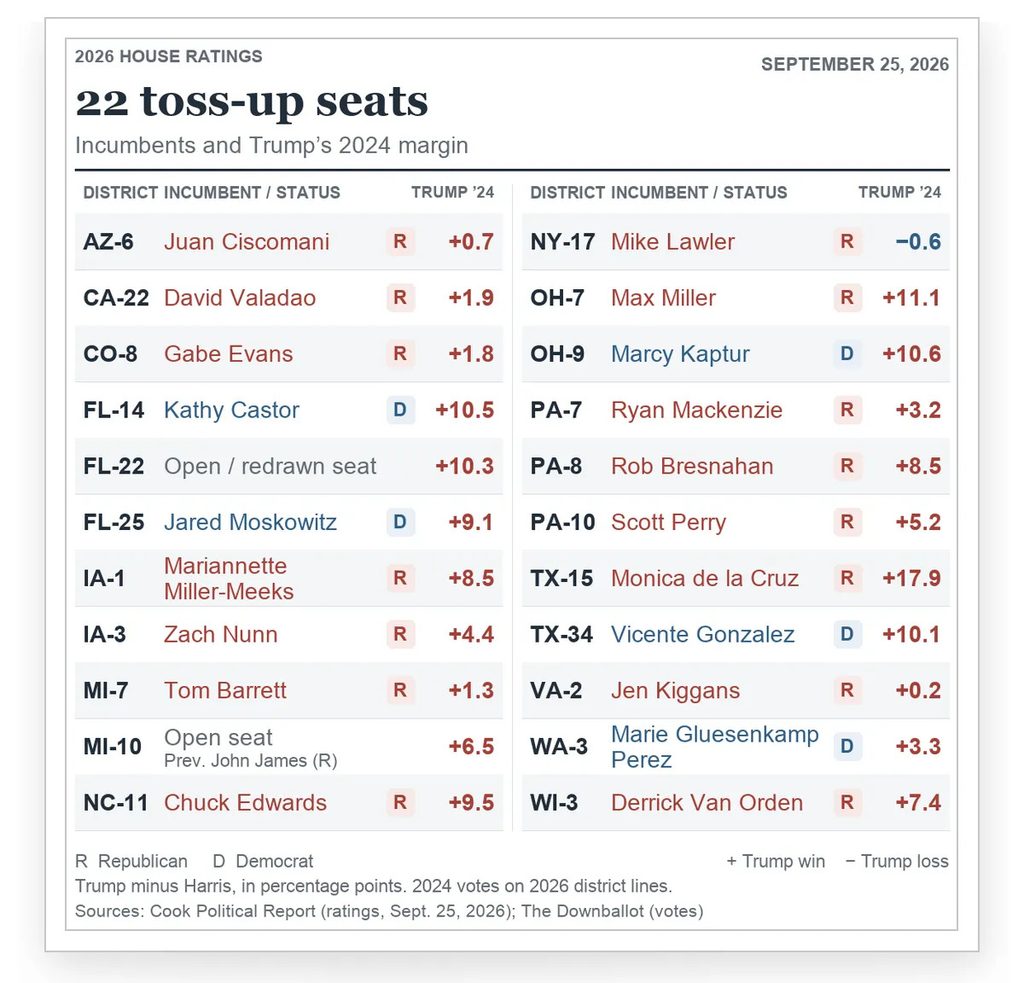
That’s it. That’s the whole list that will decide the fate of the House, and Republicans hold a structural advantage in terms of incumbency and the Trump 2024 margin. Nobody is predicting a blue wave. Polls are useless at this point, not just because the pollsters lie, but because they can’t accurately predict who’ll actually go down and vote on Nov. 3.
You still with me? To hold the House and prevent The Democrat Circus, Round Two, we need only hang onto a little over half of those 22 toss-up seats. Readers in those districts, take note. Readers outside those districts, take note if you want to help by throwing a few donation dollars one way or another.
Meanwhile, the GOP can focus on 22 House races and about six Senate races. That job is much more manageable than the corporate media keep telling everybody. (Of course, Democrats face a similarly concise target zone, which is why no one is sanguine.)
Jeff Childers is an attorney and the author of Coffee and Covid. coffeeandcovid.com