
Whoever wins tonight inherits a stalled economy, a rising pension bill, and billions in federal cuts. A tax hike would make all three worse.
By Eric Fruits
Oregonians are voting today for a governor, every seat in the House, and about half the Senate. Polls close at 8 p.m. Whoever wins will take office facing an economy that has barely added a job since 2020, prices and interest rates that are rising again, and a 2027–29 budget whose costs are growing faster than its revenue.
None of that depends on who wins tonight. What the winners do about it does.
This afternoon I presented these numbers to business owners at an event hosted by Maps Commercial and Maps Private Client. The slides from that talk are below. Here is the short version.
Is Oregon growing?
Barely. Since January 2020, Oregon employment has grown 0.2%. U.S. employment grew 4.6% over the same stretch.
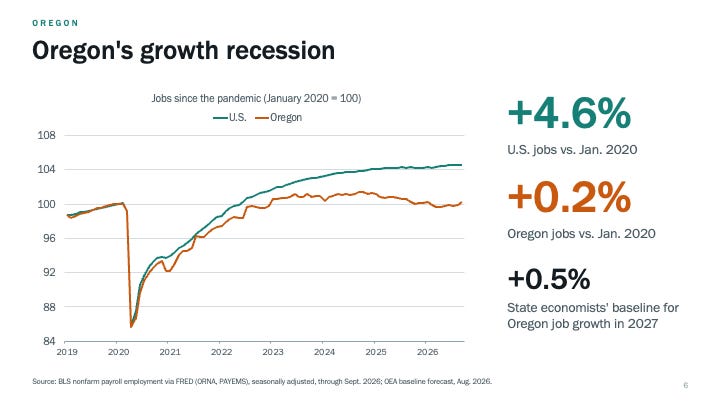
Last year, the state’s economists called this phenomenon a growth recession: an economy that is just treading water, neither sinking nor soaring.
The mix matters more than the total. Oregon has lost about one in nine manufacturing jobs since the pandemic, while U.S. manufacturing employment has barely changed. Intel’s layoffs are part of Oregon’s decline, but only part of it.
Health care and social assistance have driven Oregon’s recent net job growth, offsetting job losses elsewhere. Medicaid is a major source of revenue for the state’s health care providers, and the Oregon Health Authority estimates that the 2025 federal budget law will reduce Oregon’s federal Medicaid funding by at least $12 billion over a decade—putting that source of job growth at risk.
The state’s economists expect Oregon’s job growth to be about 0.5% over the next year. Oregon’s unemployment rate is nearly a point above the national rate, and that’s in the middle of a national expansion.
Where did the growth go?
South and north of Portland. Since January 2020, the Portland metro area has lost jobs. The Salem metro area, Marion and Polk counties, has grown faster than the country as a whole.
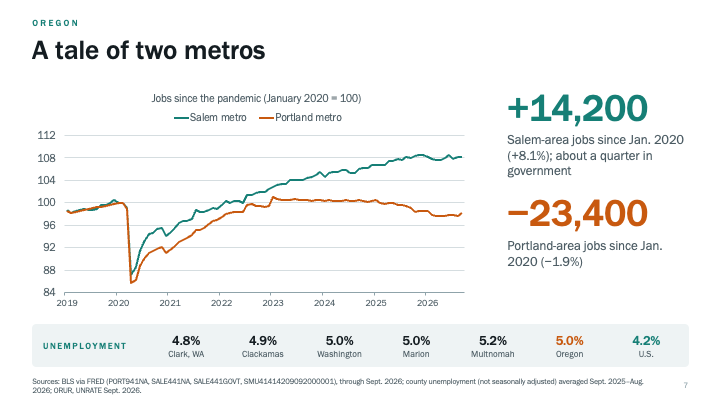
You might guess that Salem grew because the state government grew, but that’s about a quarter of the story. Most of Salem’s new jobs came from private employers, not the Capitol.
People followed the jobs. Since 2020, Multnomah County has lost about 20,900 residents, while Clark County, Washington, and Marion and Washington counties have grown.
Builders followed the people. Clark County now permits about twice as many new homes as Multnomah County, even though Multnomah has more residents.
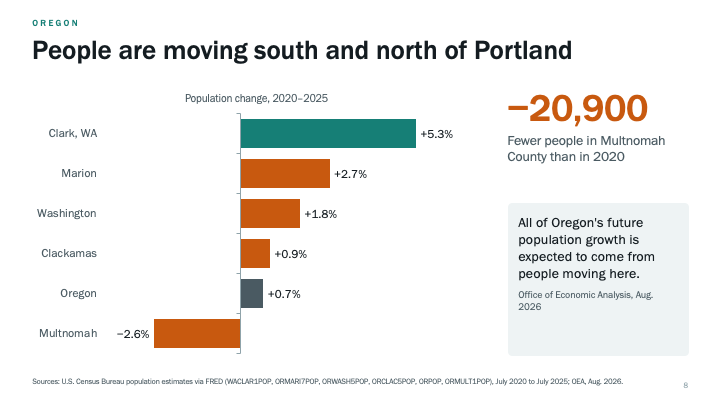
The state’s economists expect all of Oregon’s future population growth to come from people moving here. Just this week, the Oregonian reported that the number of children under 5 in Portland has fallen by more than a third since 2010. A state that depends on newcomers can’t afford to have residents fleeing its largest city.
What changed this fall?
Prices and interest rates turned back up. Inflation had fallen to about 2.4% in January. By September it was back to 3.7%, pushed up by energy prices after the war with Iran began.
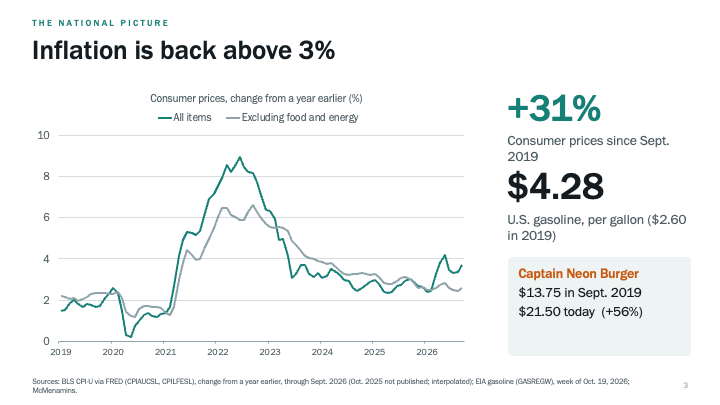
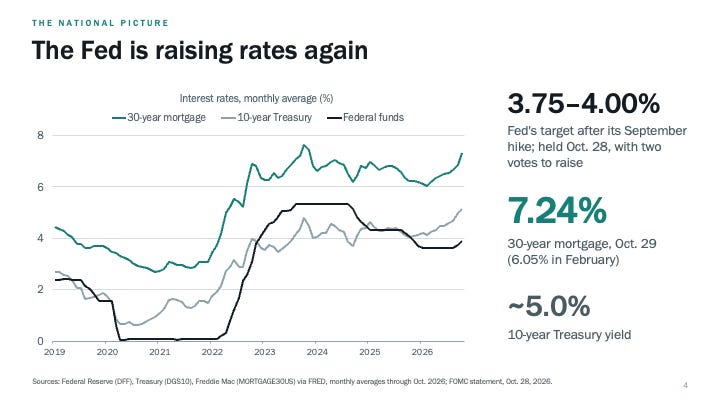
The Federal Reserve raised its benchmark interest-rate target range in September for the first time since July 2023. On October 28, it held the range at 3.75%–4%, but two members—Lisa Cook and Beth Hammack—voted for another quarter-point increase. Long-term rates have moved up with it. The average 30-year mortgage rate is back above 7% for a $500,000 loan, adding nearly $400 to the monthly payment compared with February.
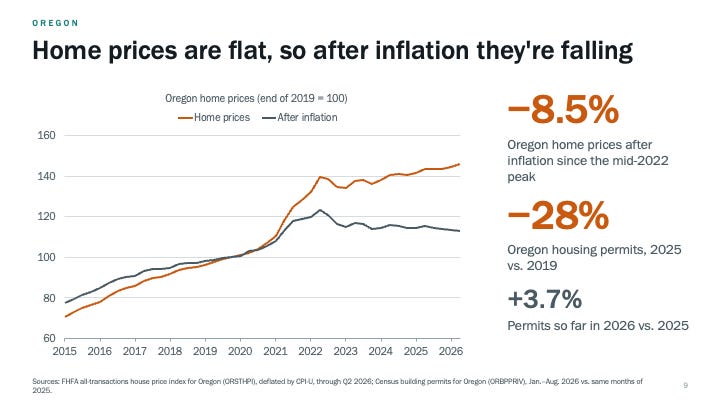
Homeowners have lost ground more quietly. Oregon home prices have been flat since mid-2022. But home prices have not kept pace with inflation; in effect, home values have declined.
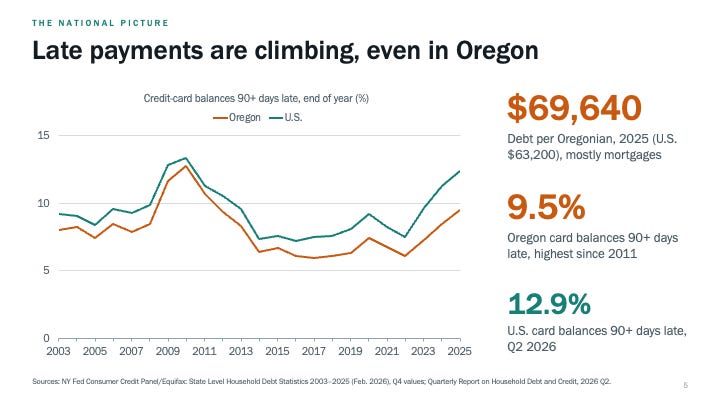
Household budgets show the strain. The share of Oregon credit card balances that are seriously past due is the highest since 2011, but remains below the national average. Even so, lenders are likely paying attention.
If state government revenue is up 18%, what’s the problem?
Costs are rising faster. The state’s economists expect General Fund revenue for 2027–29 to come in about 18% above the current budget, and they don’t expect a kicker. Four cost pressures will claim much of that money.
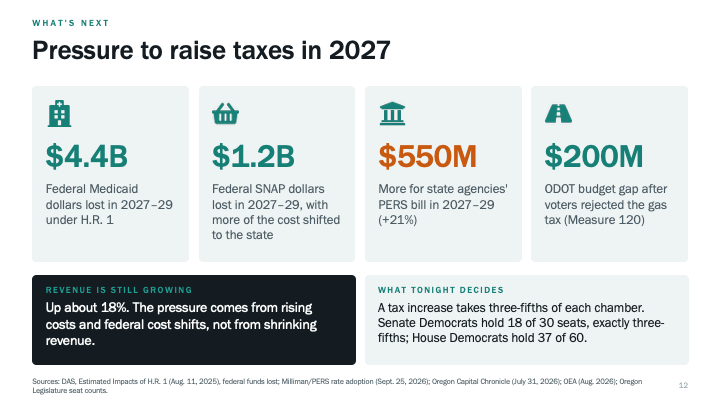
- Medicaid and SNAP. H.R. 1, last year’s federal tax and spending law, will cut billions of dollars in federal Medicaid and SNAP funding to Oregon over the next two budgets. Those are federal dollars lost, not state cost increases. The Legislature decides how much to replace. The Oregon Health Authority estimates that up to 200,000 Oregonians could lose health insurance coverage under the bill’s new work requirements.
- PERS. The pension system’s unfunded liability has shrunk, but the bill goes up anyway. More than 180 “side accounts”—lump sums employers deposited years ago to lower their rates—will run dry by the end of 2027. State agencies alone will pay about $550 million more in 2027–29.
- Transportation. In May, voters rejected Measure 120, the gas tax and fee increase, 83% to 17%. ODOT faces a $200 million gap and has identified hundreds of positions it would eliminate.
- Standing orders. The state budget office has told agencies that no new program will receive funding without an offsetting cut and has asked each agency for options to cut by 10%.
Whoever wins the governor’s race and whoever wins a seat in the legislature will face an enormous fiscal mess. There will be enormous pressure to “enhance” revenues—which is policy-speak for “raise taxes.”
Keep in mind, this is the optimistic forecast. The state’s economists put the odds of a recession at about one in six. A moderate recession would cut 2027–29 revenue by more than $2 billion. Whether 2027 brings that or the upside depends on energy prices, the Fed, and other factors outside our tiny state’s control.
Who pays if taxes go up? Who won’t pay?
Income taxes supply almost all of the state’s General Fund. Oregon has almost no sales tax, so when the economy stalls, the budget has nothing to cushion the fall.
The income tax itself leans on a narrow base. About 1% of filers pay about a quarter of the state’s personal income tax. The top 4% of filers pay 36% of state income tax, with an average state income tax bill of $54,500.
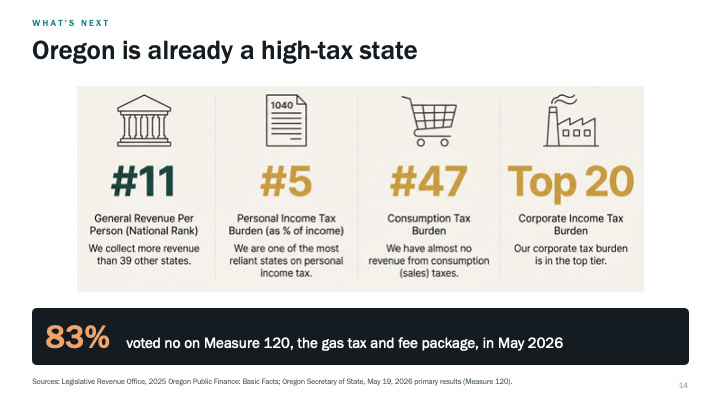
Those filers don’t have to go far to get tax relief. Clark County has no state income tax, and its population continues to grow. IRS migration data show that households leaving Multnomah County earned more, on average, than the households moving in. A tax increase aimed at top earners raises the most from the people best able to leave.
Whether a tax increase passes depends partly on tonight. The Oregon Constitution requires a three-fifths vote of each chamber to raise revenue, and Democrats hold exactly three-fifths of the Senate. Losing a single Senate seat would put them below the threshold. The next governor then decides whether to sign or veto.
What should the next Legislature do?
Hold the line on taxes.
Oregon doesn’t have a revenue problem. General Fund revenue is on track to grow 18% in the next budget. The state already collects more revenue per person than 39 other states, relies on about 1% of filers for a quarter of its income tax, and sits next to a state with no income tax. Oregon has a cost problem and a growth problem, and a tax increase solves neither.
Pay for the costs out of the growth. PERS has known for years when the side accounts would run out. The higher pension bill will take a big bite out of the 18%, but that is not a reason to raise taxes. The same goes for the federal Medicaid and SNAP cuts. How much to replace is a spending decision, and legislators should make it program by program, in public, before anyone writes a tax bill. A tax passed first settles those questions by default.
Then go after growth. Salem’s private employers added jobs over the same years the Portland area lost them, under the same Fed and the same federal budget. That gap didn’t come from Washington, D.C. It came from choices made here, and choices can change. Growth is also the only source of new revenue that doesn’t push taxpayers across the Columbia.
Whoever wins tonight will be tempted to call this a revenue problem. It isn’t. Oregon can’t tax its way out of its growth recession.
This article originally appeared on The Oregon Ledger.