
By Jeff Childers
Credit: coffeeandcovid.com
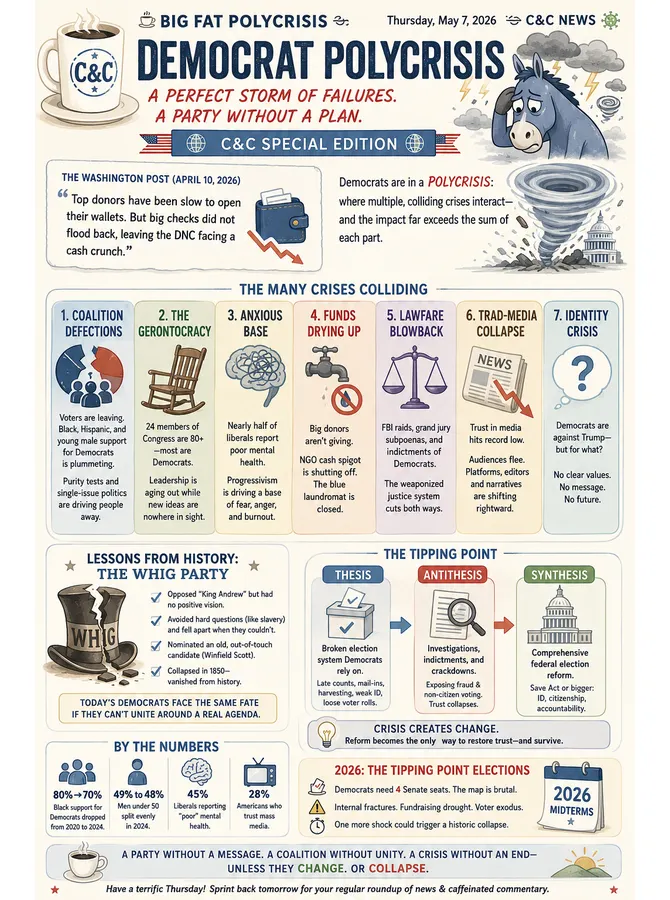
If you listen closely to the wind blowing through Washington, D.C., you might hear a faint, high-pitched whining sound. That is not the sound of cicadas fluttering through the cherry blossoms. That is the sound of the Democrat Party realizing that the check has finally arrived, and their credit card was declined. In April, the Washington Post broke a story that perfectly captures the Democrat Party’s woebegone state:
“The DNC expected big money after big Democratic wins. It never came. The Democratic National Committee has scaled back some of its plans as donors remain reluctant to give, despite candidates’ recent victories.”
For the last few years, despite occasional bouts of truth bursting through the costume’s seams, corporate media have generally assured everyone that the Democratic Party is doing fine. Sharp as a tack. A coalition of highly educated coastal elites, powerful unions, a motivated gang of highly diverse grievance groups, plus legions of narcissistic white boomers who somehow still believe that NPR is the best way to learn what’s going on in the world.
But underneath the hood, the engine was smoking, the transmission was held together by duct tape, and the bus driver was staring blankly at the dashboard trying to remember what to do when it makes that weird noise. Now, the bus has completely stalled out, parked on the side of the highway, and the passengers are sitting inside waiting for someone else to come fix it.
Corporate media are desperately trying to conceal what historians and political scientists call a “polycrisis.” As defined by historian Adam Tooze (and the World Economic Forum, which considered it an opportunity instead of a problem), a polycrisis happens “where disparate crises interact such that the overall impact far exceeds the sum of each part.” It describes where the political ground is destabilized from so many different directions at once that policymakers ultimately become paralyzed, usually while forming another gold-star committee to consider funding a new study on the destabilization.
Tooze explained, “In the polycrisis, the shocks are disparate, but they interact so that the whole is even more overwhelming than the sum of the parts.”
Throughout history, apparently successful political parties have been sidelined or even destroyed in what appears to be an instant. The U.K. Labour Party spent nearly two decades in the political wilderness after 1979, for instance. The Republicans were nearly destroyed twice in the 20th century – one 20-year “wilderness” stretch after the Great Depression and another after Watergate.
In both GOP cases, Republicans eventually recovered – once by nominating a war hero (Eisenhower), and then by finding a unifying leader with fresh, genuine, ideological clarity (Reagan). The Democrats currently have neither option available.
History’s better example might be the Whig Party, which precipitously collapsed in 1850.
All the insiders know it. Trad-media is doing its level best to distract and obfuscate, but some recent headlines are flashing red. On April 9, Bloomberg warned that “Michigan Shows Democrats’ Identity Crisis Up Close.” On March 15, Axios reported that “Democrats face a post-Trump identity crisis for 2028.” On March 30, the NDSMC Observer simply called it “The Democratic Party’s identity crisis.”
“The Democratic Party has an aura of ineffectiveness,” NDSMC wrote. “This is an existential threat.” The main problem, according to the author, is that the party is now only about opposing Trump – which manifestly is not working. So, the author argued, “with that opposition, there needs to be an alternative message. Something that voters can get behind. An idea. A value. Not the lack of values. Not just anti-MAGA.”
Jim Messina, Barack Obama’s 2012 campaign manager, agreed. “You can’t win a presidential election on opposition alone,” he told Axios. Democrats (not MAGA) are fractured. “Democrats are deeply divided over what they’d do if they returned to power,” Axios said. They intend to run against Trump in the 2026 midterms, but realize that won’t work in 2028, when Trump is terming out.
Democrats must “build a message predicated on values rather than reactions,” the NDSMC author fretted, “lest they doom themselves to a future of perpetual minority status, forever living in the shadow of the MAGA right.” But what screamed from the pages was that the author had no suggestions for a message. Not one.
The reason he didn’t is the same reason the Democrats cannot fix this problem. It’s a structural problem broken beyond repair.
Let’s dissect the anatomy of this rapidly approaching fast-motion disaster.
A polycrisis isn’t just a regular old run of bad luck. It is a structural failure. In any normal political cycle, a party could lose an election, suffer a fundraising dip, or deal with pushback against an unpopular leader. Or even all three. Those problems are manageable. You just replace the leader, change the messaging, and pretend you never actually supported the things you supported yesterday.
But in a polycrisis, the mechanisms for fixing the problems also break. The disease and the cure become indistinguishable. That’s what Democrats face. They are currently trapped in a perfect storm of intersecting, overlapping, cannibalistic calamities, each feeding and feeding off the others.
Democrats core problem is that their party has become an “odd coalition” of wildly divergent interest groups united by only one thing: opposition to Donald Trump.
When a political party has no articulable platform besides “we are not the other guy,” a polycrisis is not just possible. It becomes mandatory.
The crises unfold – coalition defections and the single-issue trap
Traditionally, the Democrat Party has billed itself as the champion of the working man and minorities. Today, it is increasingly the party of the wealthy, credentialed and highly educated. This is a big image problem when your main message is “eat the rich.”
The 2024 election exposed the fracture for all to see. Kamala Harris won 80% of the Black vote – solid, but a massive 10-point drop from Joe Biden’s 90% in 2020. President Trump secured 20% of the Black vote. The shift was even more extreme among Hispanic voters, where Trump narrowed the gap to a mere 3 points, as compared to Biden’s 25-point margin four years earlier.
Men under 50 split evenly (49% to 48%) between Trump and Harris, erasing a 10-point Democrat advantage from 2020.
Instead of addressing these defecting voters’ concerns, factions within the Democrat Party are doubling down on purity tests.
The party is essentially three blocs: Moderates (47%), Progressive Liberals (37%), and a “Woke Fringe” (11%). The median Democrat actually wants border security and safe streets, but the party is held hostage by the 11% who think math is racist, there’s an infinite number of genders, and Karl Marx was on the right track but just didn’t try hard enough.
The Gerontocracy
While the Democrat base is fracturing, while fresh, bold ideas are needed to hold it together, the leadership is calcifying. The halls of Congress increasingly resemble a retirement home with excellent benefits combined with a surprising amount of insider trading that is best characterized as estate planning.
As of early 2026, 24 members of Congress are 80 or older, over half are running for re-election, and the vast majority are Democrats. In the Senate, the median age of Democrats is 66, significantly older than their Republican counterparts.
An increasingly anxious base
Perhaps the most under-appreciated aspect of the polycrisis is the perplexing psychological condition of the Democrat base. Studies consistently show that liberals report significantly lower levels of happiness and psychological well-being compared to conservatives.
According to the 2022 Cooperative Election Study, conservatives outnumber liberals 51% to 20% among those reporting “excellent” mental health, while liberals outnumber conservatives 45% to 19% among those reporting “poor” mental health.
In their noble quest to bear the weight of the world’s injustices, modern progressives have stumbled into a perpetual state of existential angst.
The blue laundromat is closed
Running a modern political campaign requires astronomical amounts of money. For years, Democrats relied on two massive funding streams: small-dollar digital donations via ActBlue, and a sprawling network of government-funded NGOs. Both are now collapsing.
In April, the Washington Post reported that the Democratic National Committee is facing a massive cash crunch as “top donors have been slow to open their wallets.” The DNC had assured party officials that their resounding 15-point victory in the Virginia governor’s race would open the floodgates. “But big checks did not flood back,” leaving DNC Chairman Ken Martin presiding over a financial and leadership crisis.
Meanwhile, Elon Musk’s Department of Government Efficiency (DOGE) has taken a sledgehammer to the NGO complex. DOGE first targeted USAID, leading to the elimination of over 5,000 programs. These programs were rife with fraud and political grift, with taxpayer money flowing through dizzying arrays of cut-out corporations to Democrat coffers. Musk bluntly explained, “This is one of the biggest sources of fraud in the world – government-funded NGOs.”
The broader recent crackdowns on Medicare fraud, autism services and daycare funding are systematically cutting off the federal spigot that has long nourished progressive advocacy groups and political operatives. The “blue laundromat” is being condemned, and the DNC is suddenly discovering that running a political party requires actual money and real fundraising, which tends to be harder than making backroom deals with Somalian cartels.
Lawfare blowback
For years, Democrats cheered more enthusiastically than a high-school squad at tryouts while prosecutors launched unprecedented legal attacks against Donald J. Trump. Now, the weaponization of the justice system has turned out to be a double-edged sword, and currently, Democrats are holding that sword by the blade end. For example, the DOJ has issued a sweeping grand jury subpoena demanding the personal information of 3,000 Fulton County election workers from 2020. In November, several of Gavin Newsom’s political allies were indicted for corruption.
The Collapse of Trad-Media
An entirely separate problem for Democrats is the collapse of the legacy media infrastructure that has for decades carried water for the progressive platform. Trust in mass media has hit a record low of 28%. Viewers are migrating to alternative media, mostly conservative or conservative-adjacent podcasts like “The Joe Rogan Experience.”
Corporate media is shifting rightwards. Conservative billionaires Larry and David Ellison acquired Warner Brothers (which owns CNN), independent commentator Bari Weiss was installed as editor-in-chief at CBS News, Jeff Bezos’ new head of the Washington Post fired 13 “climate reporters,” and the list goes on. Furthermore, X (formerly Twitter) under Musk’s ownership allows uncensored conservative content.
Democrats are going to have to work harder to earn audience attention— but their problems are multiplied since they can’t enunciate clear policy positions anyway.
The Whig Party’s warning from 1850
To understand where this polycrisis is heading, we can look back to the 1850s and the collapse of the American Whig Party.
The Whigs were founded in the 1830s as a coalition united primarily by one thing: opposition to Andrew Jackson. Ironically, they sneeringly called him “King Andrew.”
Like modern Democrats, the Whigs were a coalition party. Because their fragile coalition included Northern industrialists and Southern planters, the Whigs needed to avoid naming specific policy platforms, which would expose their internal contradictions and anger one side or the other.
The Whigs’ fatal flaw was that they were a national party in an era when the central question of American politics – slavery – was inherently sectional. As long as slavery could be kept off the agenda, the Whigs’ coalition held. The moment it couldn’t, the party fractured and died. And a brand-new political party flowered into life (the Republicans).
Like the Whigs, today’s Democrat Party faces a similar irreconcilable fracture line. Not just one. Several of them. Immigration, police funding and trans “rights” are all solid examples. All of them are potentially slavery questions for the loose Democrat coalition. If the DNC takes a strong position on any of those issues, it will forever fracture the coalition. That’s why they can’t commit.
Tipping Points and the Hegelian Synthesis
In complex systems theory, a polycrisis does not resolve itself gradually. It builds pressure until it reaches a tipping point – a threshold where a final small change, the proverbial camel’s straw, triggers an abrupt, potentially irreversible transformation or collapse.
For the Democratic Party, the 2026 midterms represent that tipping point. They face a brutal structural map, needing four seats to retake the Senate. Midcycle redistricting, wildly exacerbated by the Supreme Court’s recent Louisiana v. Callais decision striking down minority-majority districts, has scrambled the House battlefield.
But the most profound implication of where the polycrisis is going, and what it will make politically possible, can best be understood through the Hegelian dialectic: thesis, antithesis, synthesis.
The thesis is the current, chaotic, decentralized election system with late counting, mail-in ballots, harvesting, permissive voter rolls and weak ID requirements. Democrats’ viability depends on that system, and they will fight to the political death to preserve it.
The Hegelian antithesis is the current crisis – the ongoing federal investigations in Georgia, Arizona and elsewhere, combined with aggressive crackdowns on non-citizen voting and the stalled SAVE America Act, which would mandate ID, citizenship and strict voter purges.
If the Justice Department’s investigations produce credible convictions of election workers or political figures, it will shatter whatever remaining trust exists in the system. The synthesis is the solution that comes next, having been made politically possible by the thesis/antithesis dynamic. In this case, it will probably take the shape of a comprehensive federal elections bill. Maybe the SAVE Act. Maybe something bigger.
Supporting a federal elections bill becomes the Democrats’ only way to say, “We fixed the problem,” as opposed to defending the obviously broken status quo. As Democrats scramble to plug the holes in the hull, they may soon find that the only way to save the ship is to agree to a new set of rules written by the people they spent the last decade trying to destroy.
If a strong elections bill is passed – whether the SAVE Act or something else – Democrats may save themselves, but will enter their own 20-year wilderness period while they remake themselves into a party that can maintain a coherent message. Or it may be too late, and the longest-surviving political party in American history may be buried next to the Whigs.
The Democratic polycrisis is not just a run of bad luck. It is the systemic collapse of a political coalition, a fundraising apparatus, an ideological project and an institutional support network, all happening at the exact same time. The GOP could still lose its advantage by somehow snatching defeat from the jaws of victory, as it has a bad habit of doing, but the game is now theirs to lose.
The Democrats aren’t just losing the game; they are losing the whole stadium.
Note: An extended version of this article can be read here: https://www.coffeeandcovid.com/p/big-fat-polycrisis-thursday-may-7
Jeff Childers is an attorney and the author of Coffee and Covid. coffeeandcovid.com